Women’s Work: London
Women’s Work is a Part W initiative that maps architecture, design and construction projects where women have played a pivotal role. For too long, printed maps, digital platforms and archives have overlooked women-led work.
By creating our own map, we highlight some of the places where women have led or made significant contributions in design, development, conservation, commissioning and construction.
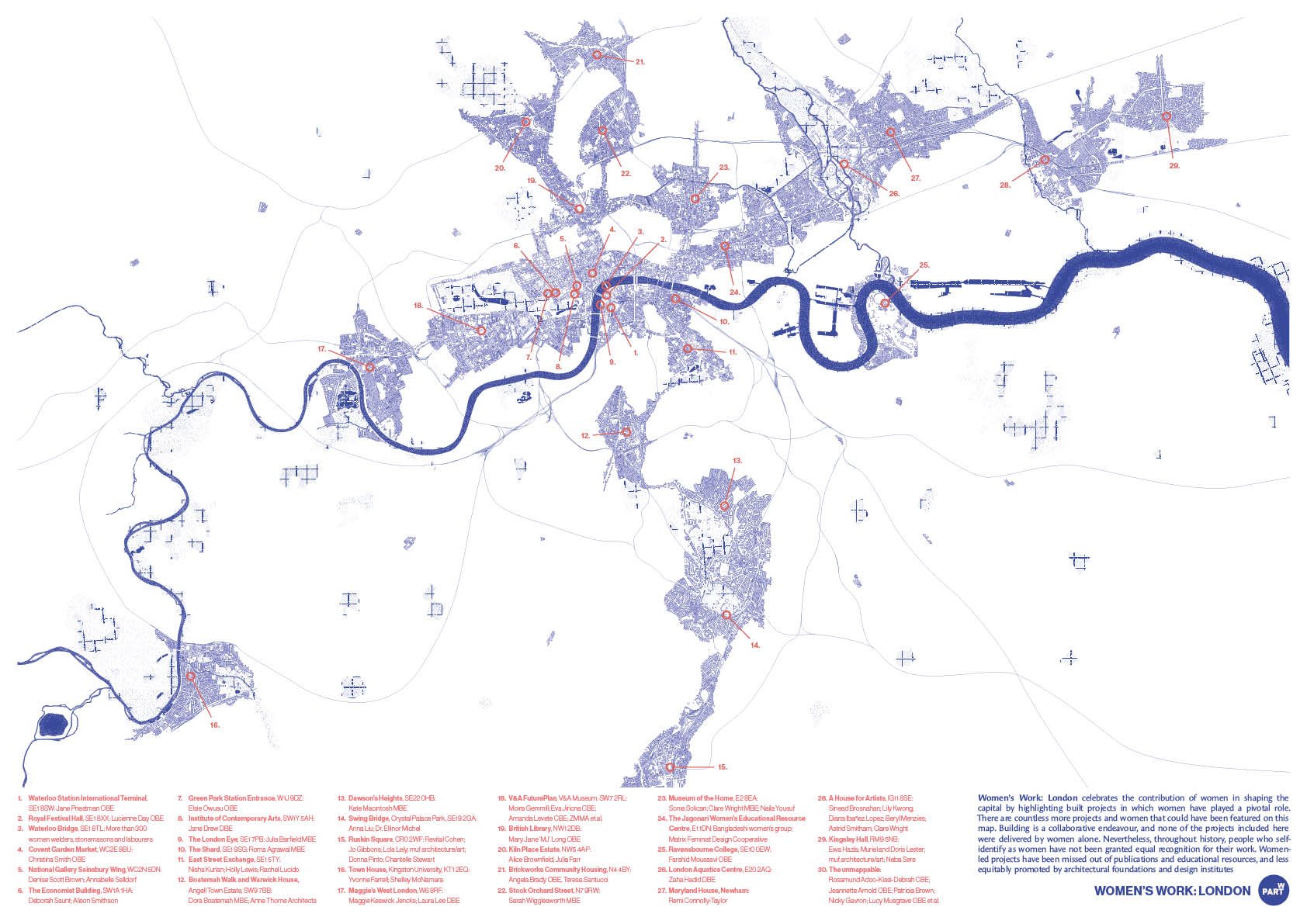
Featuring projects such as Waterloo Bridge, the British Library, the Supreme Court refurbishment and pioneering social housing schemes, the map reveals the often‑hidden impact women have had on London’s built environment.
This Part W map campaign seeks to proactively celebrate the work of those who self-identify as women from all backgrounds. and offer up examples of built works that can be visited and learned from.
By sharing these stories, we aim to challenge historic underrepresentation, offer visible role models and broaden the narratives told about architecture and design.
“The map will highlight lesser known stories of women’s significant contribution to the city around us, and spark conversations about who is (and is not) involved, represented and recognised in the production of our built environment”
Closing the visibility gap
When women’s work is undocumented, it is far less likely to appear in education, the media or online sources. Women’s Work helps close this gap by creating a public record that recognises women architects, engineers, designers, landscape architects, commissioners, conservationists, community groups and citizens.
The creation of a printed map also encourages people to step away from their screens and explore the city in person, with a visible and tangible physical copy of representation in increasingly digital lives.
Developing the Women’s Work map
The pilot was created as part of the Barbican exhibition How We Live Now How We Live Now: Reimagining Spaces with Matrix Feminist Design Co-operative. The first edition featured 20 projects selected by a Part W working group. An open call then generated more than 200 submissions, from which a panel selected 30 for the final version of the printed map.
While not all projects could appear in print - and there is a multitude of others that should be recognised - the list remains an important resource and supports our educational outreach with schools across London.

Extract from the Women’s Work map by Edit
What’s next
Launched in 2022, Women’s Work: London received the inaugural W Award for Research from the Architects’ Journal and Architectural Review. This recognition strengthens our ambition to expand the project across the UK and internationally. With partnership support and essential funding, Part W hopes to develop future Women’s Work maps and continue shining a light on the remarkable contributions of women in the built environment.
“For too long the work of women in design has been undervalued and the contribution of women has not been accounted for in mapping studies, written texts and in studies that promote role model examples of who designs our cities. This map continues work we’ve already begun recording built projects by diverse women in London - our aspiration is to achieve funding and support from others that allow Part W to expand this work UK wide and beyond.”
Our Statements
In Solidarity… An Open Letter
We, the Part W collective, speak out against the murder of George Floyd and the violent actions of the police. We stand in solidarity and call for others to join with us in shouting out that black lives matter.
An Open Letter…. In mourning, and ideas for change
Part W is appalled by the murder of Sarah Everard. As an action group of women working in the built environment, we‘re heartbroken by the seemingly casual attitudes of many in society towards the safety of women and girls in cities - and the failure to bring about change.